
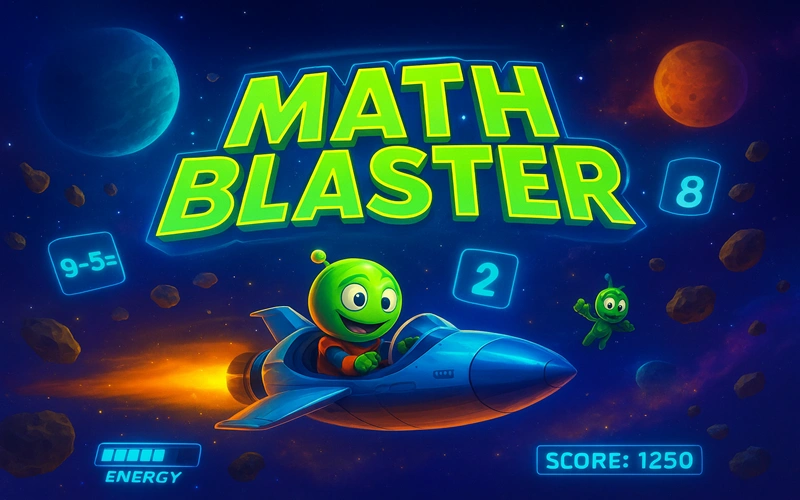
Long before smartphones and tablet apps took over classrooms, there was a game that made math feel like a high-speed space mission. It wasn’t just about solving problems — it was about blasting through asteroid fields, dodging alien traps, and saving your trusty robot companion. That game was Math Blaster, a title that brought learning and excitement together in a way that stuck with players for decades. For kids in the 90s, it was as much a part of school computer labs as floppy disks and chunky monitors. Today, it still inspires new generations to see math as a thrilling adventure rather than a boring worksheet.
A Historical Overview
The origins of math blaster! trace back to the mid-1980s, when educational software companies began experimenting with ways to make learning more interactive. Developed by Davidson & Associates, the first version of Math Blaster appeared in 1983 for early home computers like the Apple II and Commodore 64. Unlike traditional math drills, the game wrapped equations inside a colorful sci-fi setting. Players weren’t just adding and subtracting — they were pilots defending space stations, traveling between planets, and collecting alien gadgets.
The early success of the game proved that educational software could be fun without losing its academic value. Over the years, Math Blaster went through multiple makeovers, adapting to new platforms, graphics, and even different teaching approaches. By the 90s, it had cemented its place as a beloved computer lab staple in schools around the world.
Read More: Join Gimkit Class
Math Blaster 90s – The Golden Era
If you ask adults today about their favorite educational computer game from childhood, many will point to math blaster 90s. This was the era when the game’s animation became brighter, the sound effects punchier, and the gameplay more varied. While earlier versions felt like single tasks in space, the 90s brought storylines, side characters, and more creative math challenges.
One key feature was the way the game balanced fun and focus. Players could get lost in navigating asteroid belts or chasing alien thieves, but they always had to solve math problems to move forward. The combination of arcade-style action with educational goals was groundbreaking. It proved that games could keep kids hooked while still building important skills.
Math Blaster Online – A New Frontier
With the rise of the internet, math blaster online emerged, letting players connect and learn in virtual worlds. Instead of installing from floppy disks or CD-ROMs, kids could now log in through a browser and explore space-themed math missions from anywhere.
This online shift didn’t just make the game more accessible — it added a sense of community. Players could customize avatars, team up for challenges, and compete for high scores in real-time. While the graphics evolved to match modern animation styles, the heart of the game stayed the same: solve math problems, complete missions, and have a blast doing it.
Math Blaster Episode I: In Search of Spot
One of the most memorable releases in the series was math blaster episode i: in search of spot. This mid-90s adventure followed the main character, Blasternaut, on a mission to rescue his robot companion, Spot, from alien kidnappers. The journey took players across asteroid belts, alien jungles, and even mechanical fortresses.
What made this version stand out was its variety. Players didn’t just shoot asteroids — they also navigated mazes, solved pattern puzzles, and completed timed math challenges. Every task was woven into the storyline, so it felt like part of the mission rather than a separate “lesson.” This approach made it easy for players to forget they were learning at all.
The Math Blaster Game Experience
The math blaster game format was always a clever blend of arcade reflexes and mental math. Players were given a math problem, and their correct answer determined whether they successfully avoided an obstacle, collected a bonus, or defeated an enemy. The game’s pacing rewarded quick thinking — hesitation could mean losing a life or missing a target.
This structure made it ideal for developing skills like mental calculation, pattern recognition, and time management. Unlike worksheets or textbooks, the game encouraged practice through repetition without feeling repetitive. Every new round brought different problems and new visual challenges.
Math Blaster in Search of Spot – A Closer Look
While math blaster in search of spot sounds like the title above, it actually refers to both the original 1993 CD-ROM version and its later remastered editions. The premise was simple but effective: the player had to travel through dangerous sectors of the galaxy to retrieve Spot. Each sector presented a different math skill focus, from fractions and decimals to geometry and basic algebra.
The charm of the game came from its balance of story, humor, and challenge. Spot’s playful personality and the colorful alien worlds made every math challenge feel like part of an epic quest rather than an isolated task. For many kids, it was their first experience of a video game that actively improved their school performance.
Math Blaster 2000 – The Millennial Update
When the year 2000 rolled around, math blaster 2000 brought a new generation of graphics, sound effects, and gameplay mechanics. The developers updated the art style to appeal to modern kids while keeping the educational core intact. Missions became more complex, with multiple objectives in a single level, and the math problems adjusted dynamically to match the player’s skill level.
This adaptability was a big deal for parents and teachers, because it meant the game could challenge advanced players without overwhelming beginners. It was a great example of how educational games could evolve alongside entertainment technology.
Math Blaster 1996 – A Fan Favorite
Among longtime fans, math blaster 1996 holds a special place. This release blended the storytelling of earlier versions with the improved visuals of mid-90s CD-ROM games. It was particularly popular in school computer labs, where its colorful worlds and fast-paced missions stood out against other educational software of the time.
Many players remember the 1996 version for its smooth animations and memorable soundtrack. The voice acting added personality to the characters, making them feel like real companions rather than just pixel figures.
Math Blaster Games – A Series with Many Faces
Over the decades, math blaster games have appeared on an impressive list of platforms: Apple II, DOS, Windows, Macintosh, Sega Genesis, Super Nintendo, and even modern mobile devices. Each version had its own unique style, but they all shared the same core concept: blending math practice with thrilling space adventures.
The variety of releases allowed the series to reach kids with different learning styles. Some preferred the straightforward arcade action, while others enjoyed story-driven missions or puzzle-solving challenges. This flexibility helped the franchise stay relevant across generations.
Mega Math Blaster – Taking it to the Next Level
For those who thought they’d mastered the standard challenges, mega math blaster offered a tougher experience. Released in the mid-90s, it featured longer missions, more complex math problems, and faster action sequences. Players had to think quickly and strategize their moves while under pressure.
This version was particularly popular among kids who had “graduated” from easier math games but still wanted an exciting challenge. It was proof that learning games didn’t have to be simple or slow — they could push players to improve both their gaming and academic skills.
The Cultural and Educational Impact
The influence of Math Blaster goes beyond just childhood nostalgia. For many players, it was their first experience of learning through play. It showed educators that video games could be powerful teaching tools, especially when they encouraged problem-solving and quick thinking.
Research into educational gaming has since confirmed what kids in the 80s and 90s already knew: when learning feels like an adventure, motivation soars. Math Blaster didn’t just improve math skills — it built confidence, resilience, and a love for challenges.
Conclusion
From its humble beginnings in the early 80s to its online worlds and mobile updates, Math Blaster has proven that learning and fun can coexist beautifully. Whether you remember the pixelated adventures of the 90s, the cinematic storytelling of In Search of Spot, or the multiplayer missions of the online era, the spirit of the game remains the same: math can be thrilling, and every correct answer is a step toward victory. Its legacy is a reminder that the best way to learn is to make the journey as exciting as the destination.
FAQs
1. What age group is Math Blaster best for?
It’s generally aimed at ages 6–12, but older kids and even adults can enjoy its fast-paced challenges.
2. Can you still play the original 90s versions?
Yes! Some versions are available through retro game sites and emulators, though compatibility may vary.
3. Is Math Blaster only about basic math?
No — different editions cover skills from basic arithmetic to fractions, geometry, and even early algebra.
Read More: H5 Fire Kirin